 |
|
|
| Get Original Mehter CD ! |

Turkish Music |
|
This music bears the signs of local cultures and the names of their creators are usually indefinite. The folk music of our country has a structure that was formed by collecting the specific cultural values of all civilizations that have been living in Anatolia and Turkish Thrace since the old times of history and incorporating cultural differences of the regions and thus, that is rare throughout the whole world with its prosperity and diversity. Although our folk music has much diversity and difference with respect to regional characteristics, it can be reviewed under the below 6 regions in a general classification:
On the other hand, it should be kept into mind that substantial differences may exist between some cities, centers or districts located within the same region Ottoman Artistic Music This type of music, today mostly called as “Classical Turkish Music” or “Turkish Artistic Music” prospered, ripened, improved its form/esthetics and gained the identity of an artistic music in parallel with the establishment, growth and strengthening of the Ottoman State. This music gave products on many themes such as religion, love, military and war and each of these formed their respective types, forms and groups. Ottoman Artistic Music was influenced by the music cultures of new countries that joined the empire and it received and gave out elements. However, starting from the early 19th century when the empire started to retrograde and collapse, a gradual loss in depth and loosening is observed in this artistic music as well. While diverse airs and measures were used previously, this understanding was gradually abandoned and it became the entertainment music of the city. “Şarkı” type substituted almost all types in this development that lasted up to now and became more popular as it was spread. Whereas writing notes was not attached much attention until mid-19th century, many works within this scope were forgotten and diminished. The number of works that could survive to date by being written during any period is around 8000, of which approximately 3000 are those composed from 15th century until the end of 18th century and approximately 5000 are those produced in 19th century. Some more works produced in the first quarter of 20th century can be added to these works, which dated back to very old times with respect to airs, rhythms, forms and playing instruments and methods and were formed within the framework of some specific rules. The music that has been continued to be produced under the title of “Turkish Artistic Music or Classical Turkish Music” to date and gradually transformed into popular forms can be considered to be an extension of Ottoman music that transformed into today's norms. Ottoman Artistic Music is a synthesis. It bears many riches of the history. It was shared and formed together with minorities living with Turks, such as Byzantines, Turkish Greeks, Iranians, Arabs, Jews and Armenians and it reached its most brilliant era in Enderun, Ottoman Palace school. No country using this system could reach the artistic level reached by the Ottomans. Ottoman Artistic Music was formed and performed within a “Fasıl” order based on the principle of “unity of air”. Fasıl: It is the concert consisting of pieces composed in the same air by being arranged in a certain order. In a full Fasıl, there are both verbal and instrumental pieces. While forming a Fasıl, it is basic that the pieces be of the same air and they are arranged in a certain order according to their types and forms. In general, two “Beste”s and two “Semaî”s have to be composed to form a fasıl of an air. These are verbal pieces. The “beste”s are in the forms of “Murabba” or “Nakış”. “Murabba”s composed on two couplets of a “Gazel” can be with or without “Terennüm”s. Melodies formed with meaningless words such as “ten, tenen, tenenen, ten nen ni”, etc. or meaningful words such as “canım, ömrüm” (my dear, my life), etc. in accordance with the measure besides the lines of the poem forming the lyrics of the piece are called “Terennüm”. 1st, 2nd and 4th lines of the poem are related to the same melody. The melody of the 3rd line is different and in this section called “Miyan Hâne”, air passages or extensions are often made. Terennüm comes after each line in Murabba's with Terennüm. The Terennüm of Miyan Hâne can be different. In Nakış's, on the other hand, two lines are composed in connection with each other and then a long Terennüm comes. The first of verbal Semaî's, which are in the same form with Murabba or Nakış but composed in “Semaî measure”, is “Ağır Semaî” (slow) and the second is “Yürük Semaî” (vivid). In a Fasıl, verbal pieces such as “Kâr” and “Şarkı”, and instrumental pieces such as “Taksim”, “Peşrev”, “Saz Semaîsi” (instrumental semaî) and “Oyun Havası” (belly-dance air) can be added to these. Thus, the structure of a full fasıl is formed as:
The primary instrumental piece forms used in Ottoman Artistic Music are:
Measures: Measures up to 15 cycles are called “Small measures” and larger than 15 cycles are called “Large measures”. The use of two large measures together is called “Darbeyn”. There are also measure series formed by the following of several measures of each other. One of these is “Zencîr” measure consisting of five measures and has 60 cycles according to one view and 120 according to another. Within small measures, those with 5, 7, 9, etc. cycles or measures with 10 cycles such as “Aksak Semaî” are classified under “Aksak measures”. The real measure called “Aksak” is that sequenced as 2+2+2+3.
Mehter (Janissary) Music Mehter is the indication of grandeur, splendor and magnificence in Turkish tradition; it is not a means of gaiety. The sublimity and celebrity of the State echoes with the boom of drums. Concepts of the unity of people and the loftiness of the state are very important in the state understanding of the Turks. Such beliefs and traditions existed also in the Turkish states before Islam and Seljuk and Ottoman states with minor variations. There are three important symbols in this structure:
The flag and the Janissary band are very important inseparable phenomena in the Turkish state. The otağ was left upon the beat of the Janissary band and the initial steps of war raids were thus taken. In the Central Asia traditions of the Turks, the ceremony of beating the Large Drum placed in front of the tent of Khan, who was the head of the state, at certain times of the day and showing his power was called as beating or knocking Nevbet (Nevbe). Beating Nevbet was interpreted as the Khan's showing his power to the friends and enemies and particularly frightening the enemies. The Janissary band, which was maintained as a sacred asset like the flag in the Ottomans, besides being an important indicator of independence and state's existence, used to stimulate and excite the feelings, encourage the troops and moralize the army with the epic airs that it played and demoralize and defeat the enemy with the great boom that is caused in field battles, fortress besieges and sea battles during the attack launched against the enemy. In field battles, one single khan's large drum was a band on its own. The khan's large drum used to determine attacks and pauses and the Janissary band consisting of drums and pipes used to direct the army in war. Defeat in war was admitted upon the plunder of the Janissary band. Therefore, the most severe battles were around the flag and the Janissary band. It is clear that the Janissary band was in some sense away from being merely a music group in the battlefield and its musical aspect was more evident during peacetime. During peacetime, the Janissary band was an indication that the khan's sultanate and the state life continued. Moreover, the drum and the band also used to perform information and announcement works of the state. The Ottoman Janissary band consisted of aerophones such as shrill pipe, pipe, kurrenay and band whistle, and membraphones or patting instruments such as large drum, drum, timbale, cymbal and stick. The number of instruments was kept equal and the factor of the band was determined on the basis of such number. The Sultan's Janissary band, which was called “Tabl ü alem-i hassa” and was the greatest, had nine factors. This meant that there was nine from each instrument. This number later increased up to twelve, even sixteen. Besides the Sultan, the Prime Minister, Members of the cabinet and the Minister of Finance and Foreign Affairs also had Janissary bands and Janissary bands used to work in various counties and fortresses of the country. The influential power of the Janissary band was also assessed by the Europeans and Military Music groups, “Bands” were established in various European countries by taking the Janissary band as an example.
Religious Music The music used in obligations, Sunna and excess worship, call to worship, assistance or decoration under the requirements of the Islam religion and called as “Şer'i (Canonical) Music” and “Tasavvufî (Mystic) Music” according to the manner of utilization and as “Mosque Music” and “Convent Music” according to the place of performance can be handled under the general title of “Religious Music”. Forms with an important place in Islam worship such as “Tilâvet” (Koran reading), “Ezan” (call for prayer), “Salevât”, “Temcîd”, etc. are included in “Mosque Music”. The music performed by various mystic paths, particularly Mevlevî's and Bektâşî's, in their ceremonies including also some kind of religious dance, “Mevlevî Âyin”s (rites) and Bektâşî “Deyiî “Deyiş”s and “Semah”s are classified in the “Mystic Music”.
|
|
Folk Music Samples |
||||||||||||||||||||||||||||||||||||||||||||||||||||||||||||||
|

|
Ottoman Artistic Music Samples |
||||||||||||||||||||||||||||||||||||||||||||||||||||||||||||||||||||||||||||||||||||||||||||||||||||
Ottoman Music - Modern Samples
Mehter (Janissary) Music - Samples
|

|
Religious Music Samples |
||||||||
|
|
FOLK INSTRUMENTS |
|---|
|
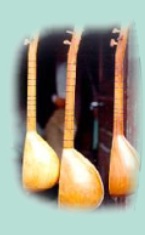 b) Played with fingers 2- Bow Instruments
3- Wind Instruments 4- Percussion
You can also listen sound samples of the instruments.
Top
picture: Fethiye - Muğla, String
instruments belonging to Ramazan Günger |

The Folk
Instruments and Turkish Music Samples has
been obtained from Turkish Ministry of Culture http://www.kultur.gov.tr.
Thanks for supporting...
 |


 |